everything wrong with crypto social trading, and why, a decade later, it never grew.
social trading is the most dangerous good idea in crypto. follow the winners, copy their trades, win without the work. instead, every cycle, millions show up, do exactly that, and become the reason the others win.
the easy explanation is that they were careless, or greedy, or just unlucky. it is also the wrong one. when a majority of rational players make good decisions and still lose on average, the game itself is the problem, not the people playing it.
it does not stop at the trader. the founder who gets a wave of users watches them gone by the next cycle. the investor keeps backing good teams into the same bad ending. one structural flaw produces all of it, and it has always been there since the beginning.
by the end of this you will know what that is, why it forces every player at the table to lose at the same time, and the one change that removes it. you will also understand why crypto, a decade and trillions of dollars in, didnt grow. because they turn out to be the same answer.
onchain is a trading floor.
crypto is the oldest activity in finance, running faster.
we tell a story about onchain as a new kind of money. underneath the story, the thing people actually do is trade. it has always been the thing they do.
crypto is a microcosm of the larger financial world and a sped up copy of it. the same cycles, arriving faster and leaving faster. the same narratives, forming and dying in weeks instead of years.
none of that is unique to crypto. what crypto changed was the clock speed and the access.
the mechanism has never changed, the venues got better. the rails got faster. supply meets demand on a chart that moves on attention. the infrastructure improved a thousandfold.
trading is the only crypto product.
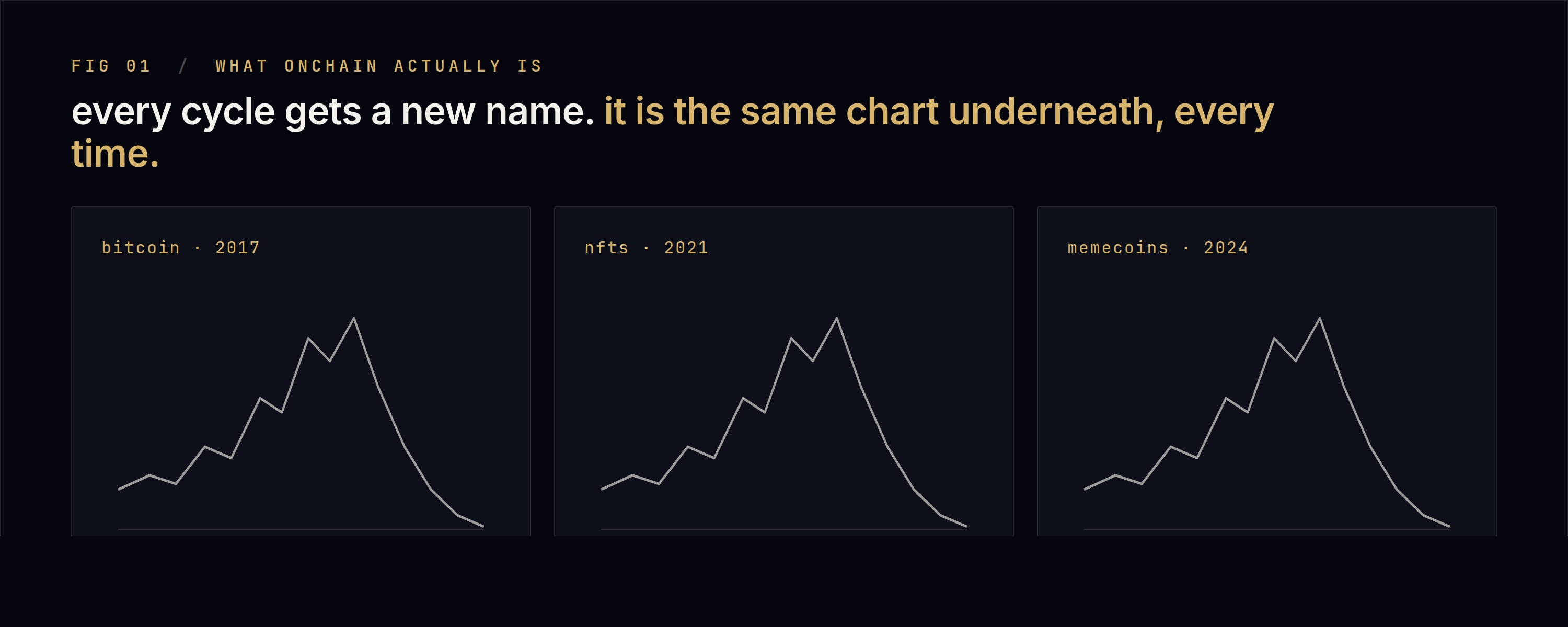
every wave of adoption has been a trading wave.
be honest about the product-market fit. it is trading. it is the biggest reason anyone comes in, and it is the only thing that has ever pulled users in at scale. last cycle it was memecoins, dragging in millions of new wallets. this cycle the heat moved. different wrapper, but all of it is trading.
so the health of the crypto industry is not some abstract function of decentralization or throughput. it is the health of its trading layer. if trading works, crypto works. if trading is broken, everything built on top of it inherits the break.
this forces the real question. is the trading layer actually working?
a healthy market lets selfish people win. crypto does not.
markets are supposed to reward edge. when they instead punish everyone, the design is broken, not the people in it.
here is the part that gets blamed on bad actors. a market is supposed to be a room full of selfish people trying to make the most money they can. that is the feature, not the bug.
in a well-built market, that selfishness is exactly what produces price discovery, routes capital to the people who allocate it best, and leaves the whole thing positive sum over time. losers exist. capital still forms. the better informed player wins, and the system compounds.
crypto trading runs the same selfish players but produces the opposite result. the winning move is not being a better trader, but rather the winning move is being earlier to other people's money and timing your exit into their entry.
skill decouples from edge. the rational play stops being allocation and becomes extraction. when every rational actor optimizes for extraction, the median participant loses, capital does not form, it just rotates from the newest entrant to the oldest one and then leaves the system.
that is the problem. it is that the structure pays people to extract instead of to be right.
so the question is structural. what is it about onchain trading specifically that flips edge into extraction?
the flaw is the thing crypto is proudest of.
everything is public, in real time, forever. it is the problem.
go to first principles on why crypto trading is supposed to be better. it is fast. it is permissionless, so anyone can launch anything without an exchange or an ipo. it is liquid.
it is social, because trading has always been social, built on who is in, what they think, and what everyone is about to do. so crypto took the social part and maxed it out. every position, every entry, every exit, every thesis, all of it public, live, and permanent. then it built a product directly on top of that openness.
this is social trading, and it is the loudest pitch in the space right now. you can see what every trader holds and what they made. you can follow the ones who are winning. you can copy their trades automatically, in real time, with one tap. the promise is that you no longer need an edge of your own. you just need to find someone who has one and ride behind them.
it is an easy thing to want, and it works as onboarding. it pulls in people who would never trade otherwise, and it sells transparency as the honest version of the game to be the fix for something that used to be played in the shadows.
but you cannot borrow an edge. a position is information, and the instant it is public it is information everyone has. opening the book up does not make the game honest. it strips the only thing that made trading worth doing, which was knowing something the rest of the market did not.
the public record that is supposed to keep traders accountable is the same record that lets them be picked apart. follow it to every player at the table and watch what it does to each one. spoiler: everyone loses.
player one: the good trader, whose edge dies the moment it is seen.
an edge is information the market does not have yet. share it and you lose your own advantage.
a real trader's entire asset is the piece of information the rest of the market does not have. an entry nobody else sees yet. that is the whole edge.
walk the sequence, the trader places the position. onchain, that position is public the moment it lands. the same record is now read by people.
copiers crowd the identical entry until the price the trader needed is gone. faster bots see the order coming and take the fill ahead of it. the move that was supposed to belong to one person now belongs to the crowd, which is the same as saying it is no longer a move. the better the trader, the faster this happens, because the better the trader, the more eyes are on the book.
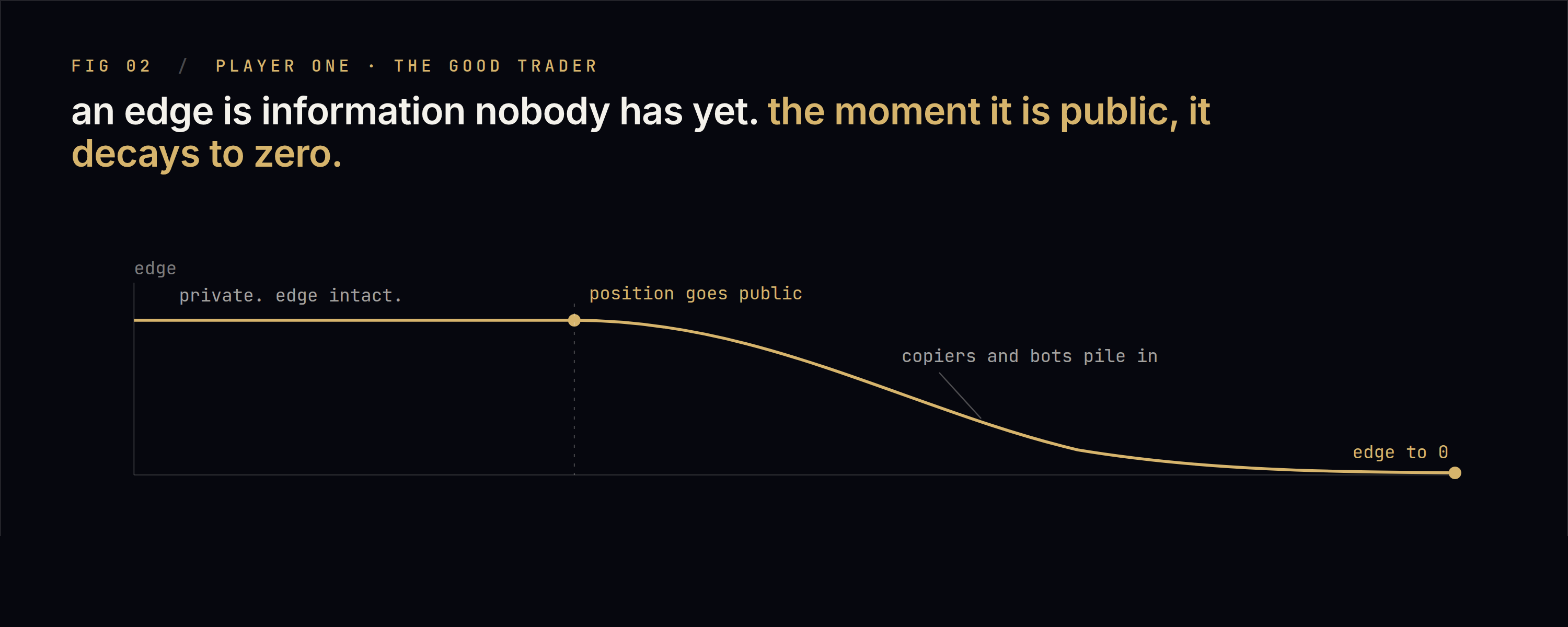
so the genuinely good traders do the only rational thing left. they leave, or they never post, or they only ever show the trades that no longer matter. the venue that promises to surface the best traders is built to drive them out.
so think about who is left. if a real edge cannot survive being public, then everyone still trading in the open for an audience is self-selected to be someone whose edge was never the point.
they are not there to monetize trades the market can already copy. they are there to monetize the one asset the platform actually rewards, which is the audience watching them.
social trading does not surface good traders. it surfaces good performers, and pays them to convert a following into other people's money.
that only works if someone is on the other side of it, following. that is the second player.
player two: the follower, who is not being guided but harvested.
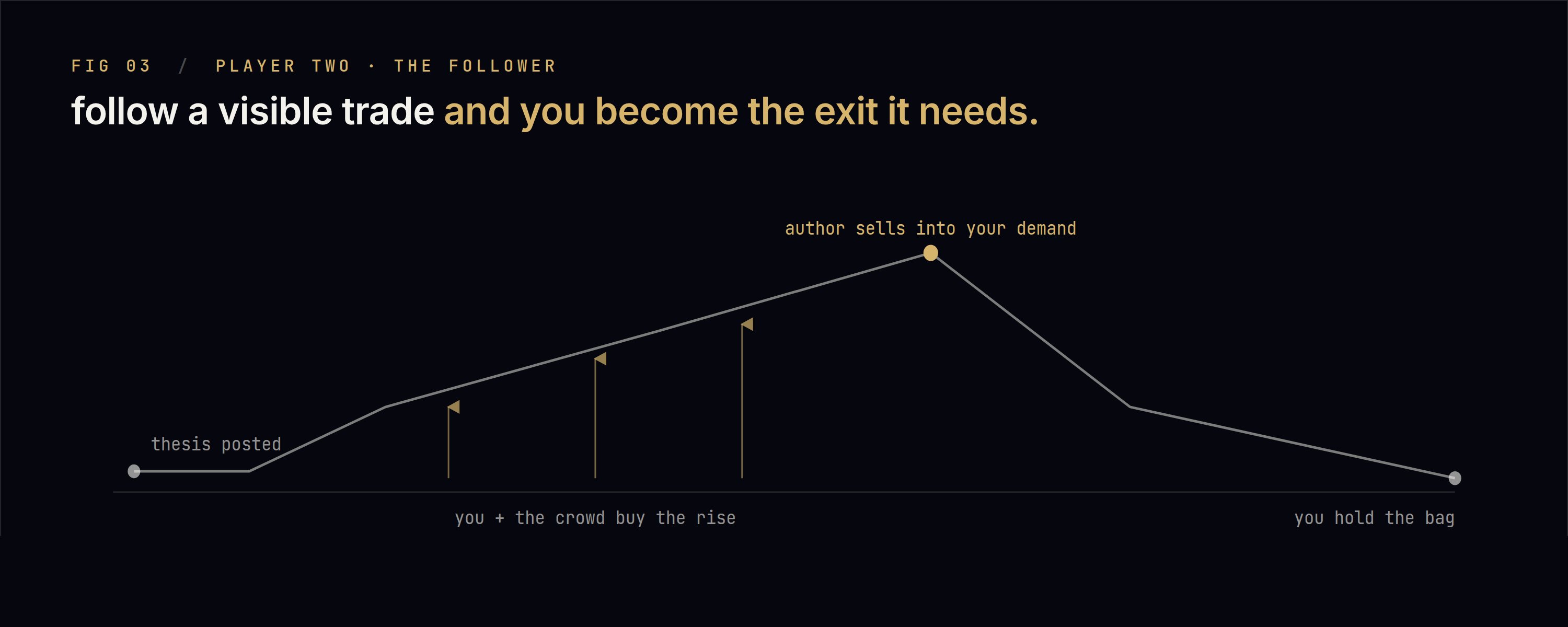
when the trade is visible, the person you follow is not your signal. you are their exit.
now sit where most users sit. you are not the trader. you are reading "here is what he bought, here is the thesis, here is why he is holding," and you decide to ride along.
the trader posts the thesis, which you read off the same public record everyone else does. you and the rest of the followers pile in. the price rises, and it rises specifically because you piled in, which makes the thesis look correct in real time.
it is correct, right up until the author no longer needs it to be.
then the exit happens, and it happens into the exact wave of demand the thesis created. you are not early to his idea. you are the liquidity his idea was for.
this is not an accusation against any one person. it is the shape of the incentive, and the shape does not care about intent.
it is also the exact engine under every social trading feed: an open venue with a following mechanic pays the person in front twice, once for being early, and again for selling to the people who arrived late on the strength of his post.
in fact, this is one of the most consistently documented patterns in retail finance. studies of social and copy-trading platforms find that the majority of followers lose money, and the design is part of why.
when people can watch someone else win, they take more risk, trade more often, and crowd into the exact positions the person they follow just took. the open book does not hand the follower an edge. it makes the follower the most predictable money in the market.
as such, what we see is that the model does not reward good trading. it rewards being early to other people's money. so the good trader cannot win honestly, and the follower cannot win at all.
the market starts to larp, and larping kills it.
when the visible game is performance and the real game is exit timing, the signal is fake.
once edge cannot survive in the open, an audience is the only asset that still pays. posting conviction, flexing pnl and narrating a thesis feeds into the plan you are already selling into.
the game is no longer a market reading information, but a room full of people larping a market at each other. capital flows to the best performer instead of the best allocator, to the loudest instead of the most right.
player three: the venue, which burns the users it just acquired.
each cycle onboards a cohort, extracts it, and watches it leave. the house is eating its own customers.
zoom all the way out. the retail user is the asset the entire industry is desperate to acquire, because retail brings the attention and the liquidity that every bull market runs on.
the bull market draws the cohort in near the top. the structure routes their capital to the people who were already there. they leave when the price falls. then it repeats with the next cohort.
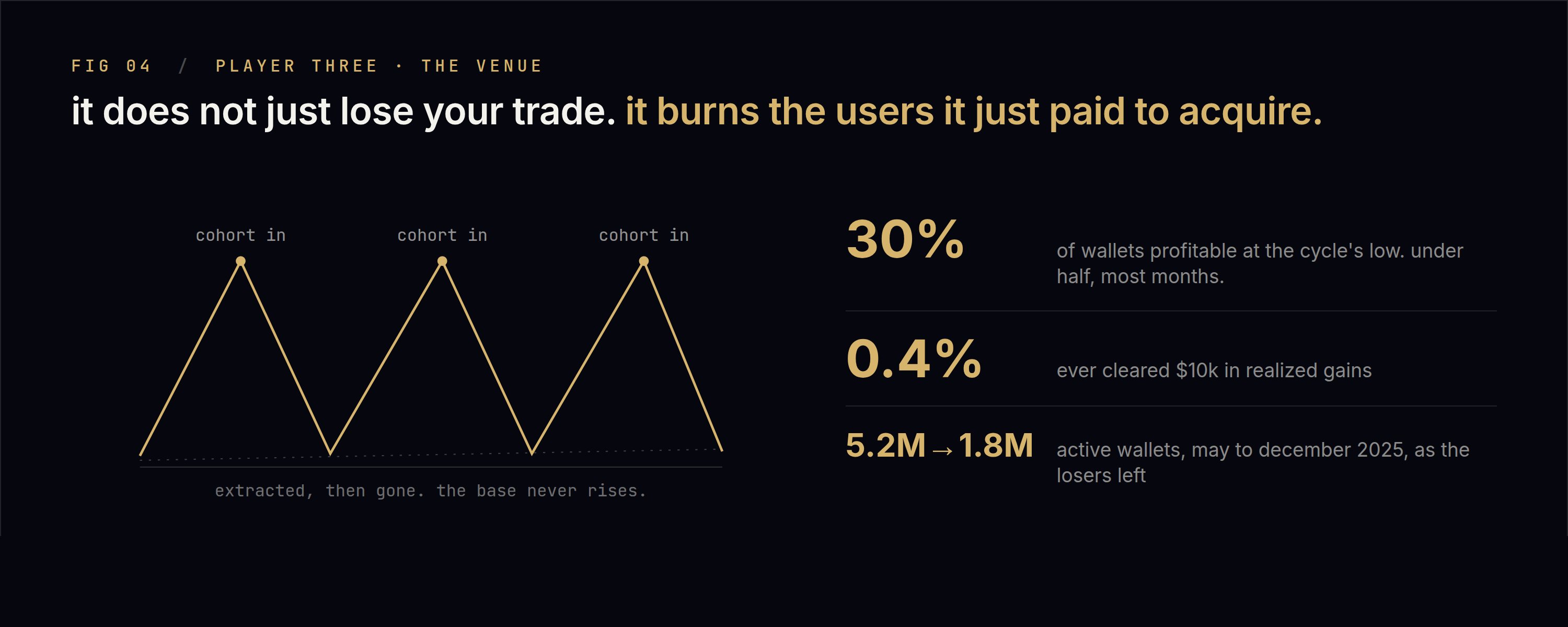
look at pump.fun through 2024 and 2025, in most months fewer than half of its active wallets closed a month in profit, and at the bottom of the cycle barely three in ten did.
only about 0.4 percent of all wallets ever cleared ten thousand dollars in realized gains. the platform peaked at 5.2 million active wallets in may 2025 and bled down to 1.8 million by december, as the people who had been extracted simply left.
but then, profitability finally improved in 2026, and not because the venue got fairer, but because the unprofitable traders were already gone. the rebound looks like a natural exodus of the people who lost. the cohort got fed in, got taken, and left, and the figures only got better once they were no longer in the sample.
so the venue does not just lose individual trades for individual people. it churns out its own user base as the cost of running.
this is why crypto never grew.
every other technology compounds its users. crypto burns them every cycle.
put the three players together and the macro picture is completed. the good traders leave or hide. the followers arrive late and get harvested. the venue burns the cohort it just acquired. nothing compounds. the user base does not grow across cycles, it resets. adoption is a sawtooth, not a curve.
that is the answer to the question the whole industry keeps dancing around. a decade in, crypto has roughly the same single product and roughly the same retention problem it started with.
this is not because the technology failed, but the trading layer sitting on top of all that technology eats the users faster than the technology can bring them in.
the root cause
the ideal version of trading is genuinely good. on these rails it is impossible.
strip the apps away and there is a clean idea underneath. a real edge wants more capital behind it, because the same edge on more size is simply more money. capital with no edge wants the reverse, a trader who has one. the two fit together.
if you have the capital, you back the trader who has the edge. you become their LP, they trade it, and they are paid only out of the profit they make you, a slice of a number that did not exist before they went to work.
if you have the edge, you run the same deal from the other side: raise outside capital and trade a bigger book than your own. either way, money ends up behind the people who can actually use it.
onchain, this should be effortless, and it should be permissionless. in tradfi, starting a fund is gated behind auditors, fund admins, prime brokers, etc. a chain is supposed to delete all of that, so anyone good enough can spin a fund up and let capital find them on merit. that was the entire promise.
it has never worked, and not for lack of trying. the deal runs into one conflict the rails make unavoidable.
backing a trader takes two things at the same time. their edge has to stay intact, or you are funding a strategy the whole market has already copied. you also have to be able to verify what they are doing, or you are trusting a screenshot. an edge you cannot check is a gamble. a track record you cannot trust is a story.
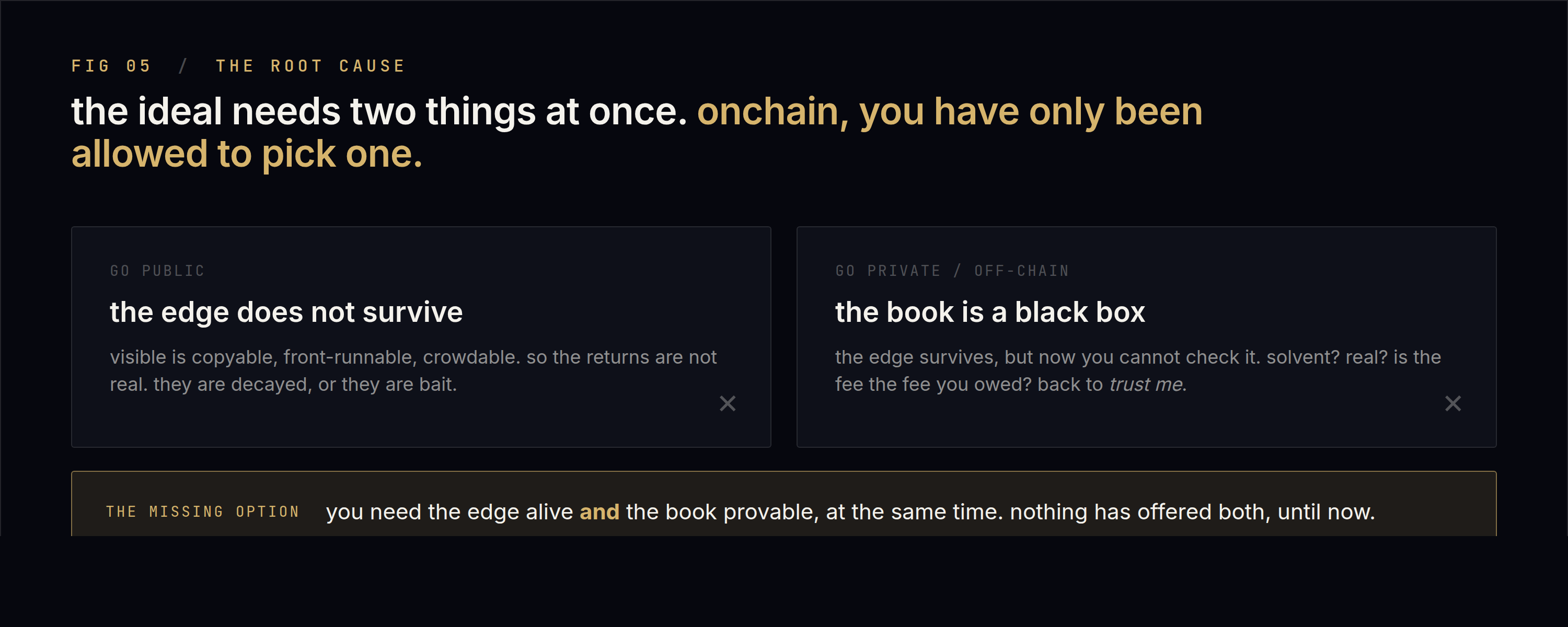
onchain, those two requirements have always pulled against each other. make the book public, the way the open market does, and you can verify everything, but the edge is gone the moment it is visible, copied and frontrun until the returns mean nothing.
keep the book private and the edge survives, but now you cannot check any of it. is the trader solvent? are the returns real? is the fee the fee you were owed? you are back to trust me, the exact thing the chain was supposed to delete.
so the only choices have ever been visible and worthless, or hidden and unverifiable.
that is the engine of the churn.
you do not have to choose.
the conflict only exists if checking a thing requires seeing it.
here is the assumption hiding underneath both options: that to verify a book, you have to publish it. that trust requires disclosure. for most of financial history that was simply true, you audited by looking. it is not true anymore.
a zero-knowledge proof lets you prove a statement is true without revealing the data behind it. applied here, a fund can stay completely private and still prove, to you, the exact things you needed to check. that it is solvent. that the returns are real. you stop needing to see the positions, because you can verify the outcome they produced.
that is why the answer is privacy and verifiability together, and why neither one alone was ever enough. privacy keeps the edge alive. verifiability earns the trust. Sirius runs both as a single system.
private execution. the trade happens in an environment visible only to you and your LPs. there is no public book to copy, no resting order to frontrun, no flow for anyone to sell into. that one change undoes both failures above at the same time. the good trader's edge survives being capitalized, because the market never sees it, so the people worth backing finally have a reason to show up instead of hide.
the follower stops being anyone's exit, because the leak and the exit ramp were always the same public record, and now there is no public record. without privacy, there is nothing here worth allocating to, the edge would die on contact exactly as it does today.
zero-knowledge verified state. privacy on its own is just the old black box, the offchain fund that keeps its edge and asks you to trust it. the proof is what makes the privacy safe to put money behind. every block, the protocol carries a zero-knowledge proof that the rules held. that the book is solvent, that the returns are real, and that the LP was paid correctly.
you check every one of those without seeing a single position, because the proof attests to the outcome. the track record stops being a screenshot and becomes a fact, one nobody can fake and nobody can quietly delete. without the proof, privacy is indistinguishable from a scam. without privacy, the proof would have nothing left to protect.
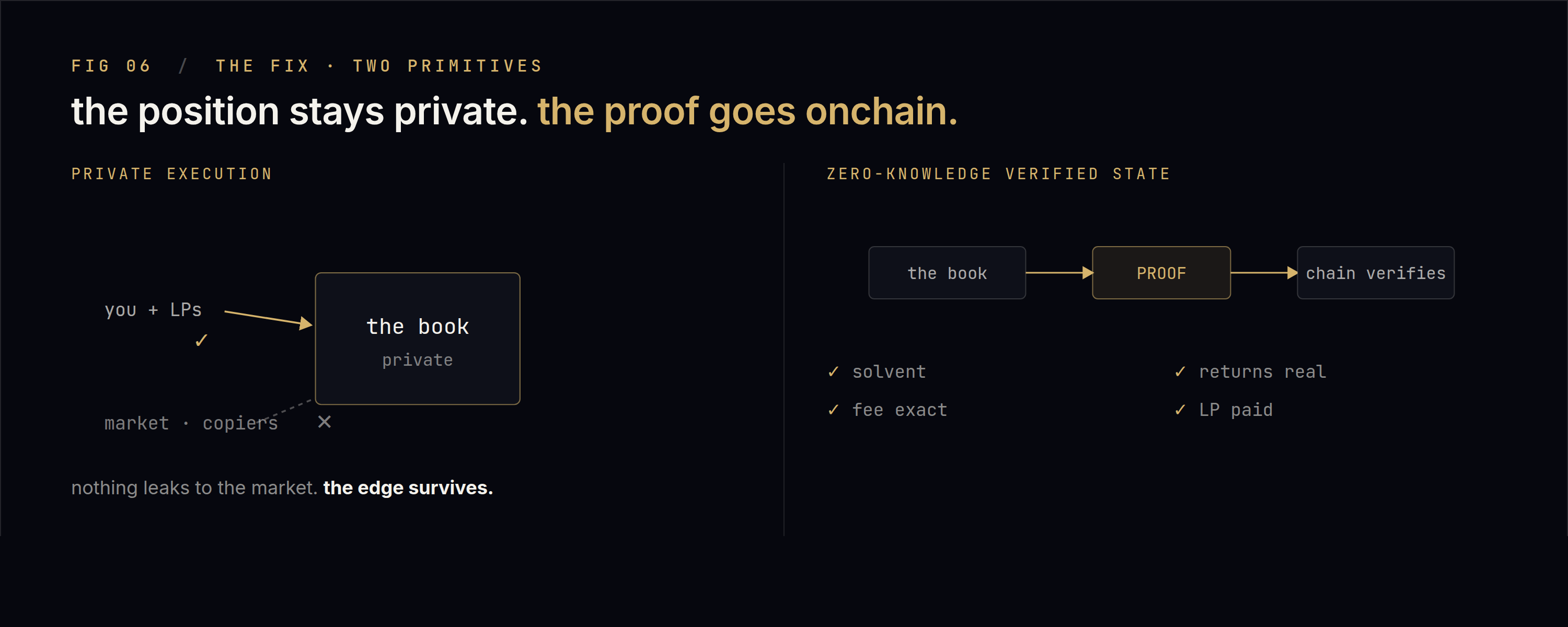
put the two together and you get the first place the ideal can actually stand.
what that looks like: the onchain fund model.
back the better trader, become their LP, and pay them out of profit that a proof certifies is real.
here is the model in full, the ideal made possible.
you deposit into a vault and become the manager's LP. the manager runs the book inside Sirius's private execution environment, where positions, sizing, and entries are visible to the fund's LPs and to no one else.
nothing leaks to the market, so the manager's edge survives being capitalized, which is the exact thing the open venue destroyed.
if you are the good trader, this is the first time you can run a fund onchain without asking anyone for permission. you spin up a vault, take LP capital, and trade. the zk proofs are your track record, earned without ever showing your book. the proof is the credential, and capital finds you on merit instead of access.
the protocol emits a zero-knowledge proof of the fund's state. that it is solvent, that the NAV you are looking at is honest, and that the returns are real. you get a continuously audited track record with no auditor in the loop, and a fee that cannot be quietly inflated. the terms that used to live in blind trust, the fee, the lockup, the risk limits, live in code instead.
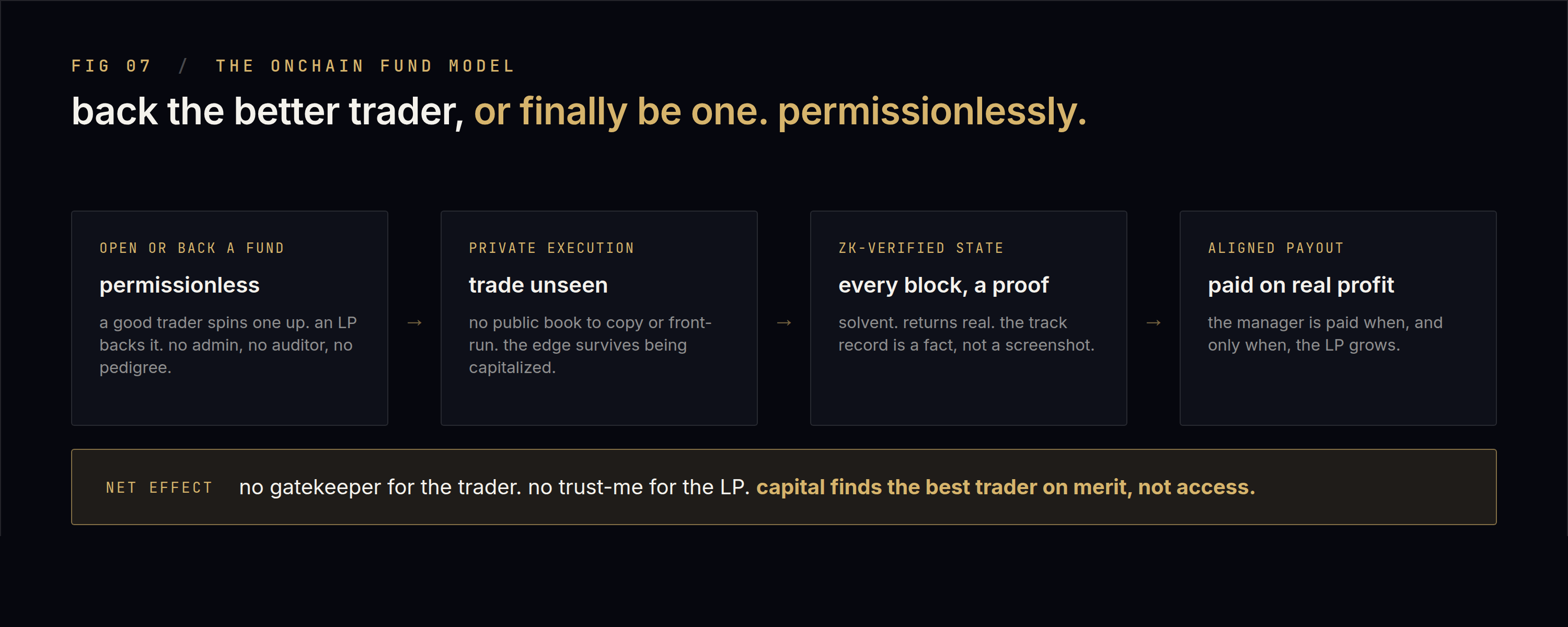
now read the incentive off that structure. the manager gets size at a lower cost of capital and keeps their edge, because nothing leaks.
the LP gets verifiable performance and a provably correct fee, because the proof does not lie. and the payout aligns the two completely since the manager is paid when, and only when, the LP's capital has actually grown, out of a profit the chain has already certified.
nobody's gain is built on the next cohort's entry. the loop that needed a constant supply of fresh exit liquidity to keep turning loses the only thing it ever ran on.
that is also the first version of crypto trading that could let a user base compound instead of reset. an entrant who is not automatically the exit is an entrant who can still be here next cycle.
retention is a structural problem, and this is the structure that fixes it.
it was never two problems.
so why does every trader lose money. why has crypto, after all this, never really grown.
these were never two questions. a market built so that being seen kills your edge is a market where the only paying move is to extract from whoever showed up last, which means the people who show up last always lose, which means the user base can never compound, which means the thing never grows.
the fix is not more social transparency. making trading louder and more social and more public, is the disease in the cure's disguise. the fix is to prove what happened, exactly, to the people with a right to know, and to no one else.
a good trader should be able to raise capital on a record nobody can fake. an allocator should be able to back one without being shown the book. you should never have to choose between an edge that is real and a record that is true.
Sirius is the venue where you do not.