
The smartest move in trading is to back someone better than you. Built the way it is onchain, the depositor loses, the operator loses, and only the house wins.
On paper, a user-led vault is very simple to implement in finance. However, in practice it becomes PvP and everyone at the table loses.
Start with why these exist, because the idea is genuinely good.
Some people are simply better at trading than you. You are not going to out-trade them, so the rational move is to hand them your capital, let them run it, and take a share of whatever they make.
That is a user-led vault. Copytrading with the plumbing built in. An operator with real edge runs a strategy, you deposit, your money trades alongside theirs, and when they make you money they keep a cut.
This is not a management fee model, but they earn only when you earn. Their own capital sits in the same pool, so they sink or swim with you.
On paper it is the cleanest alignment anyone has ever drawn up. The person with the alpha gets paid for the alpha, and nothing else.
But the moment you look at how it actually runs, that alignment turns into its opposite. It becomes ultra PvP, and honest players lose, while taking all the downside and blind spots.
This right now is not a good feature with a lot of bugs. It is an unfinished product, and it is being wound down.
So let us walk through how a user-led vault really works, every place it leaks, and the one thing an architecture would have to do to make it work the way it promises.
How it actually works
The design is simple, and that is part of why it looks so safe.
Anyone can launch a vault. You put up a minimum stake, and as the operator you have to hold at least 5% of the vault at all times.
Depositors come in and get a share of the pool equal to their deposit over the total. When the vault makes money, you take 10% of the profit above its previous high.
Two details matter more than the rest here.
One, the operator runs the vault and also keeps a personal trading account on the same venue. They pick which one places any given trade, so one person sits on both sides of the table.
Two, withdrawals are not free. If someone pulls out and the vault is short on spare margin, it force-closes its own positions.
Those two facts are where most of what the following attacks comes from.
Now the problems
You would think something this simple and this fair would just work. It does not.
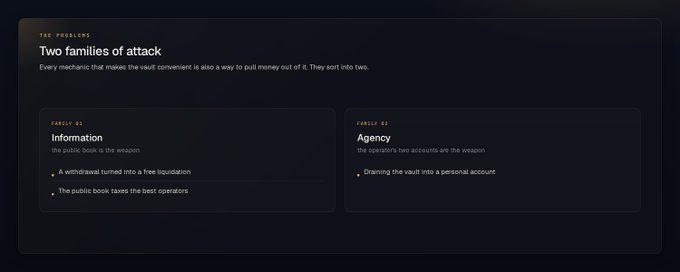
Every mechanic that makes a user-led vault convenient is simultaneously a way to pull money out of it. It is a real part of why these vaults are already being wound down since a design where every honest participant loses is not one that you can patch.
The failures come in two directions. Information, where the public book is the problem. Agency, where the operator's accounts are the problem.
A withdrawal can be turned into a free liquidation
The first one is the cleanest money. You can use someone else's withdrawal to force a vault to sell into you at a discount.
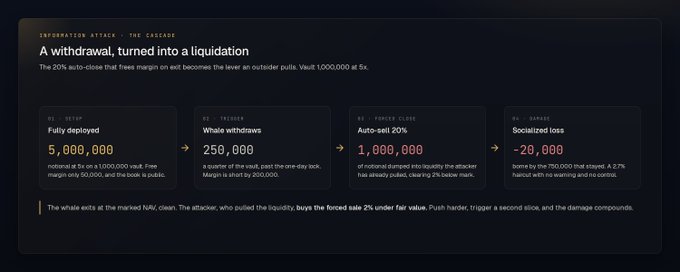
When a withdrawal is too big for the vault's spare margin, the vault dumps its own positions in 20% slices to free the cash.
Now with the public book, anyone can see exactly what the vault holds and how little margin it has left.
So you wait for the vault to be fully deployed and thin on margin. You push the market against its positions to drain the headroom. A large withdrawal then forces the vault to market-sell straight into the hole you dug, and you are standing on the other side buying.
For example, a vault holds 1M at 5x, so 5M of positions, with maybe 50k of spare margin. A whale pulls 250k so the vault is short on margin.
The vault auto sells 1M of positions into the liquidity you pulled, clearing 2% below fair. That is a 20k loss, landing on the depositors who stayed, a 2.7% haircut they did nothing to cause.
The whale then leaves the position clean, buying 1M in size at a 2% discount.
A public book taxes operators worth following
The good operators are the ones you can least afford to follow, because the moment their edge is visible it stops being an edge.
This one does not even take an attack. It only takes understanding.
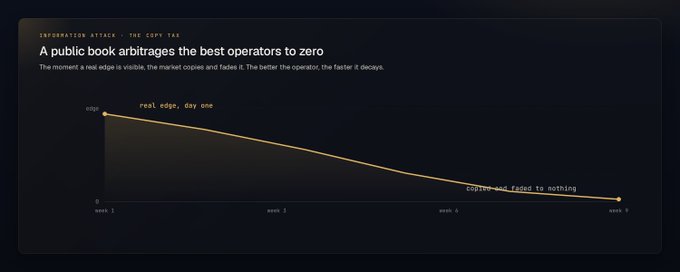
Every position the vault holds is public in real time. So if an operator has a signal worth copying, the market copies it and front runs the next move.
The better the operator, the faster their alpha gets arbitraged to nothing by people riding their public fills for free.
Transparency in this case does not punish the frauds, but punishes exactly the people the product was supposed to let you back.
An operator can move your money into their own pocket
The 5% floor is supposed to make self-dealing irrational. It does not, since the operator can sit on both sides of the trade.
The operator runs the vault and has their own account on the same venue, and they choose which one trades.
So they pick an illiquid market with a wide gap between buy and sell prices, buy as the vault at a deliberately bad price, and sell as themselves at that price. The vault books a losing trade. Their personal account books the winning side. Nothing breaks a rule.
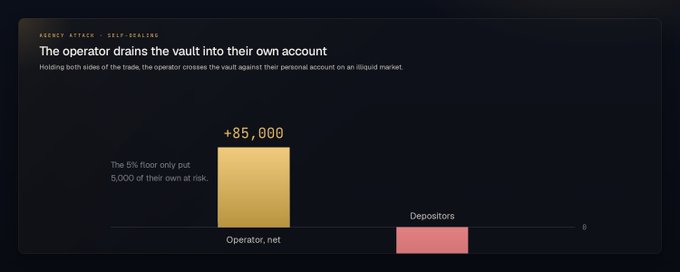
For example, same 1M vault with operator holding their 5%, so 50k of their own in the pool. They cross 100k out this way, call it 90k after the gap between buy and sell prices they burn.
The vault drops to 900k. Their stake eats 5% of that, which is 5k, while their personal account is up 90k.
Net, they walk with 85k that was yours, and the 5% floor meant to keep them honest cost them 5k to get around. You can watch it onchain after it happened but you cannot stop it.
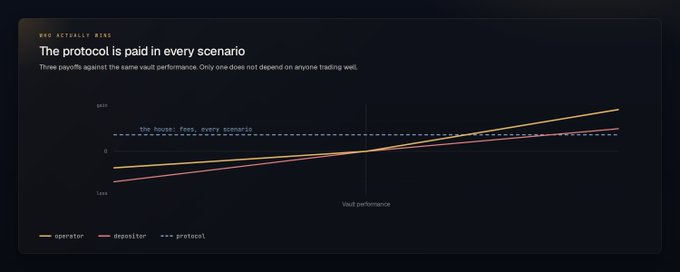
The house gets paid no matter what
Step back and notice who is on the winning side of all of them. The venue is paid in every single scenario above.
Every forced close, every cascade slice, and every panic exit is a trade. Every trade pays a fee. Launching a vault costs a fee. Relaunching after a blowup costs another.
So the one participant whose return does not depend on anyone trading well is the venue itself.
That is not a flaw or a bug. It is the design of the whole thing. A feature where the depositor loses, the honest operator loses, and only the house wins is not aligned.
It is fundamentally flawed and this is why it is on its way out.
What would actually fix this
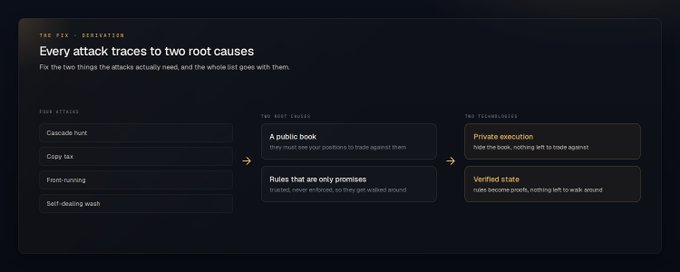
Step back from the list and every attack traces to only two root causes. Fix those two and the whole list goes with them.
Look at what the attacks actually need.
The cascade hunt, the copying, the front-running, all of them need the same single thing: a public book. They have to see your positions to trade against them. That is the entire information family, and it exists because the book is broadcast to the world.
Now the rest. The self-dealing wash needs one thing too: nothing forces the vault to trade at a fair price. The 5% floor is supposed to make draining the vault irrational, but it is just a promise the operator walks around, crossing the vault against an account they control at a price they picked. Nothing checks the price.
It is trusted, and trust is what keeps getting exploited.
So a fix does not need a hundred features. It needs to do exactly two things, because there are exactly two causes.
Hide the book, so there is nothing to trade against.
Make the rules unbreakable, so there is nothing to walk around.
Hide the book: private execution
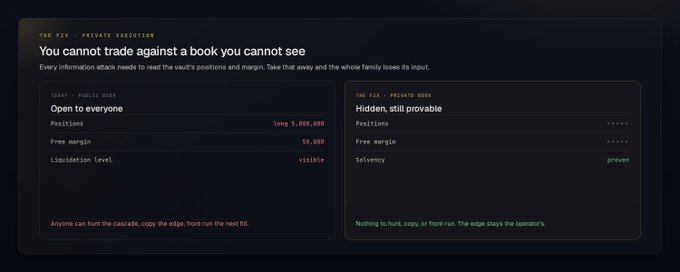
Keep positions, sizes, and the levels where the vault would be force-closed off the public surface entirely.
How it works is simple: the vault's trades run inside a private rollup. The world can verify the vault exists and is solvent, but it cannot see what the vault holds. The book is computed and settled without ever being broadcast.
Why it kills the information issue is because every one of those attacks needed to see the book first.
The cascade hunt needed to read the margin headroom, but there is none to read. The copiers needed the positions, but there are none to copy. The frontrunners needed the next fill, but they cannot see it coming.
The attacks are not defended against. They lose the input they ran on, so they stop existing.
This is also the move that breaks the trap the entire category is stuck in.
Every existing vault has to choose between transparent, which gets it hunted, and opaque, which means you cannot trust it.
Private execution alone would just be the opaqueness. The way out of that trap is the second part.

Make the rules unbreakable: verified state
Going private solves the hunting, but it reopens the oldest problem in finance: how do you hand money to someone whose book you cannot see.
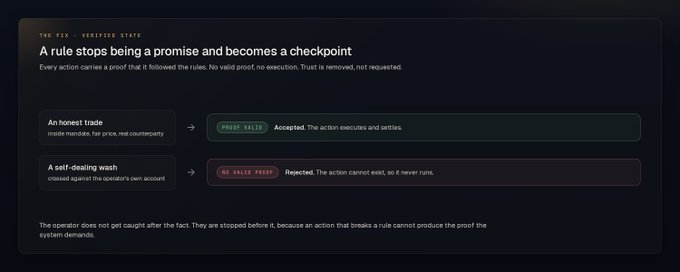
Verified state answers it. Every block the vault produces carries a proof that its state followed the rules, and the chain checks the proof instead of the operator's word.
So the operator proves what you actually care about without showing you a position. That the vault is solvent. That the returns are real, not invented. That the fee taken is exactly the fee owed. The track record stops being a screenshot and becomes a fact, one nobody can fake or wipe.
What you are left with
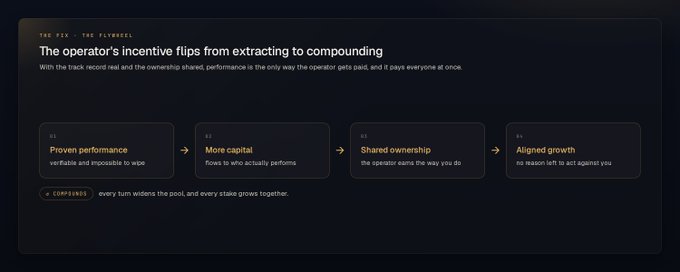
Do all of that and the operator's whole incentive flips from extracting to compounding.
Because the track record is now real and cannot be wiped, capital flows to the operators who have actually proven they perform.
The operator earns by growing a pool they own a real share of, which is the same way you earn. Perform, attract more deposits, and everyone's stake grows together.
Better performance pulls more capital. More capital widens the ownership. And the reason to act against the depositors is gone, because the structure no longer rewards it.
The one risk left, which is the only one that should be
There is exactly one risk all of this does not remove, and removing it was never the point. The operator can still be wrong.
A private, verified, properly aligned vault that makes a losing trade still loses money. That is no longer a gap in the design.
Strip out the hunting the self-dealing and the house, the only thing left between you and a return is whether the operator can actually trade.
That is the one risk you signed up for when you decided to back someone better than you and it is the one a real operator wants to be judged on.
So the job of the platform was never to promise returns. It was to remove every risk that is not the operator's edge, and then get out of the way.
Do that, and the profitable traders and real funds finally get a venue where doing the right thing is the only thing that works, where their skill is the whole product, and nothing structural is hunting, or gaming them on the way through.
User-led vaults were sold as decentralized funds but shipped as extraction machines.
The fix was never better players at the table. It is an architecture where misbehaving cannot execute, and sustained performance is the only path to getting paid.
That architecture, private execution and verified state, where the rules are checked instead of trusted, is what we are building.
Follow @Sirius_Protocol for more.